When your wife says she needs space, it can be surprisingly hard to hear the words for what they are.
Your mind may immediately jump ahead.
Is she leaving?
Should you explain yourself one more time?
Should you send a message so she knows you care?
How much space is too much?
What if giving her space makes things worse?
Those questions may matter later. But they are usually not the first problem to solve.
The first goal is to stop making decisions from panic.
A request for space does not tell you, by itself, exactly what your wife feels about the marriage. People can ask for distance because they are overwhelmed, tired of conflict, uncertain about what they want, trying to think more clearly, or because the relationship has become difficult for them.
The words alone do not tell you which explanation is true.
So instead of trying to decode the entire marriage tonight, start with the next decision that is actually in front of you.
Take the request seriously
If your wife has clearly asked for space, treat that as a real boundary rather than an opening argument.
That does not mean you have to agree with everything she thinks about the marriage. It does not mean you are admitting that the relationship is over. And it does not mean you have to stop caring.
It simply means you do not try to talk her out of the boundary in the moment.
A common reaction is to think:
If I could just explain what I meant…
or:
If she understood how much I love her, she wouldn’t need this.
That can lead to another conversation, another long message, another apology, another attempt to get reassurance.
The intention may be love. The effect can still be pressure.
If someone has just asked for less interaction, giving them more interaction in order to explain why they should feel differently usually moves in the wrong direction.
Do not turn “space” into a strategy for getting her back
There is another trap that looks calmer but is still driven by the same anxiety.
You decide:
Fine. I’ll give her space. Then she’ll miss me.
Now every day of silence becomes a test.
Did she notice I stopped texting?
Is she wondering what I’m doing?
Should I wait three days or five?
Will she come toward me if I pull away?
That is not really respecting space. It is still trying to manage her reaction.
You cannot use the right amount of silence to manufacture a particular emotional outcome.
Space is more useful when you treat it as exactly what it is: a reduction in pressure while both of you deal with what is actually happening.
Whether that eventually helps the marriage is something you cannot know yet.
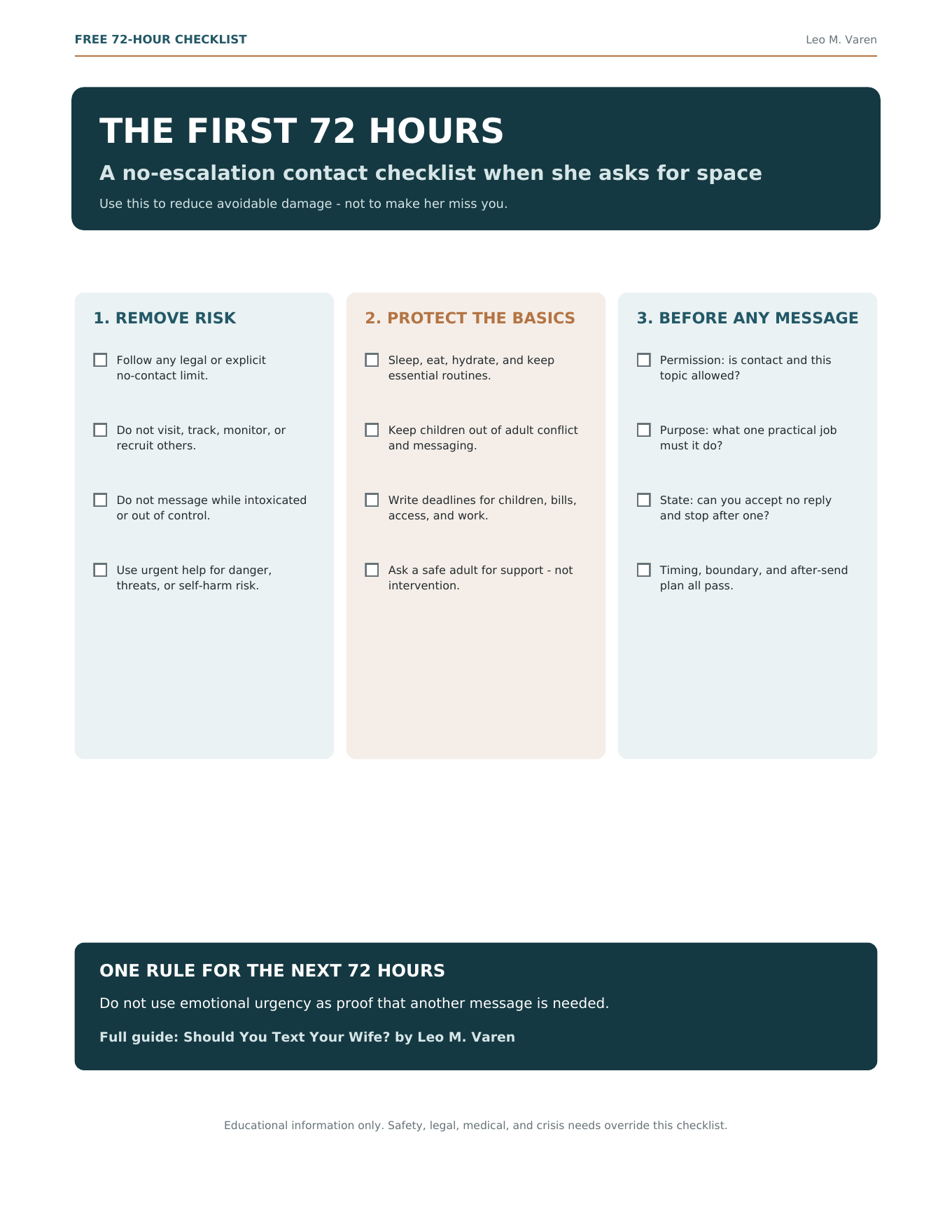
Separate emotional urgency from practical urgency
Right after a request for space, almost everything can feel urgent.
Most of it is not.
There is a difference between:
I need to know whether she still loves me tonight.
and:
We need to decide who is picking up the kids at 4:00.
The first feels urgent because uncertainty hurts.
The second may genuinely require action today.
This distinction matters.
If there are children, work schedules, bills, travel, medication, property, appointments, or another real logistical issue that cannot wait, practical communication may still be necessary.
Keep it practical.
You do not have to use a scheduling question as an opportunity to reopen the relationship conversation.
If the matter can wait, let it wait.
A useful question is:
Does this contact have a clear job to do, or am I hoping it will reduce my uncertainty?
Those are not the same thing.
If she clearly said not to contact her, do not search for loopholes
Sometimes “I need space” is vague.
Sometimes it is not.
If your wife said something clear such as:
Please don’t text me.
I don’t want to talk right now.
I’ll contact you when I’m ready.
then the decision is simpler.
Respect what she actually said.
Do not switch platforms. Do not send something through a friend. Do not decide that a goodnight text “doesn’t count.” Do not manufacture a practical reason to make contact.
Necessary communication about children, safety, legal obligations, or genuinely time-sensitive logistics may be different. But emotional discomfort by itself does not create an emergency.
If there is a safety issue, threat of violence, medical emergency, concern about a child, or another serious urgent situation, handle that as a safety or professional matter rather than as a relationship communication problem.
Do not make permanent decisions in the first wave of panic
The other extreme is reacting to her request by immediately deciding the marriage is finished.
You may feel angry, humiliated, frightened, or rejected.
You may want to protect yourself by saying:
Fine. Then we’re done.
That can be just as reactive as begging her to stay.
You do not have to decide the future of the marriage tonight simply because the present feels uncertain.
There may eventually be difficult decisions to make. There may also be conversations that need to happen.
But clarity is usually easier to find after the immediate emotional temperature comes down.
For now, your job is smaller.
Make the next 24 hours boring
This may be the least dramatic advice you receive, which is partly why it can help.
Eat something.
Go to work if you are supposed to work.
Take care of the kids.
Sleep before making major decisions if you can.
Talk to one sensible person rather than six people giving you six theories about what your wife “really means.”
Write the message you want to send somewhere private instead of automatically sending it.
Do something physical.
Stay away from alcohol-fueled conversations and late-night relationship essays.
None of this fixes the marriage.
That is the point.
Right now, you are trying to avoid turning one painful moment into five new problems.
What should you say if you have not responded yet?
If she asked for space and you genuinely need to acknowledge it, you usually do not need a speech.
Something simple may be enough:
I hear you. I’ll respect the space you’re asking for. We can handle anything practical that needs handling.
Then stop.
You do not need to add a paragraph proving your love.
You do not need to ask whether she still loves you.
You do not need to negotiate when she will miss you.
And if she specifically asked for no contact, even an otherwise reasonable message may be unnecessary. The exact boundary she gave you matters more than a generic script.
Later, we will deal separately with the harder question of whether you should text at all, because that depends on what she actually asked for and whether there is a genuine reason for contact.
What does giving space actually mean?
This is where people often want an exact rule.
No texting for seven days?
Thirty days?
Wait until she contacts you?
There is no universal number that fits every marriage.
Space after one bad argument is different from space during an active separation. Living in the same home is different from living apart. Shared children create practical communication that couples without children may not need.
So do not invent a countdown yet.
For the first stage, “giving space” means something simpler:
Stop adding unnecessary pressure while you work out what the situation actually requires.
We will cover the timing question separately because “How long should I give my wife space?” deserves a real answer of its own rather than a throwaway paragraph here.
The question to ask yourself tonight
Not:
How do I get her back?
Not:
How long do I have to wait?
Not even:
What does this mean for our marriage?
Ask:
What actually needs doing today?
Maybe there is one practical message.
Maybe there is nothing.
Maybe the next useful decision is simply not sending the message currently sitting in your drafts.
That can feel painfully small when your marriage feels like it is hanging in the balance.
Small is okay.
You do not need a complete relationship strategy tonight.
You need to get through the first stretch without turning fear into pressure.