“Separation” can sound like one clear event.
In real life, it can mean very different things.
Your wife may mean she wants separate bedrooms for now.
She may want one of you to move out.
She may be asking for a trial separation.
She may see separation as the first step toward divorce.
If you hear the word and immediately start arguing about whether the marriage is over, you can miss the practical information you actually need.
You do not have to agree with the separation to get clear about what she is asking for.
First, find out what “separation” means in this conversation
Do not assume that you and your wife are using the word the same way.
Ask concrete questions.
“Are you asking for us to live separately?”
“Are you thinking of this as a trial separation, or have you made a decision about ending the marriage?”
“What needs to change this week?”
“What do we need to decide now, and what can wait?”
You are not trying to negotiate the whole relationship in four questions.
You are trying to understand the immediate reality.
A separation is difficult enough without each person acting from a different definition.
Separate practical decisions from relationship decisions
The practical list can become long very quickly:
Who sleeps where?
Who stays in the home?
What happens with the children’s routine?
How will school pickups work?
What bills need to be paid this week?
How will you handle shared vehicles, pets, mail, or household responsibilities?
When will you communicate, and through what channel?
Those questions matter.
They are also not the same as:
“Do you still love me?”
“Are we getting divorced?”
“Is there any hope?”
“Why are you doing this?”
Trying to answer both sets of questions in the same conversation can make everything harder.
Handle what actually needs a decision.
Leave the history of the marriage for a conversation that has room for it.
Do not agree to major arrangements just to stop the pain
When you are afraid of losing the marriage, you may want to say yes to anything that seems to reduce conflict.
That can include housing, money, parenting schedules, property, or formal agreements you have not had time to understand.
Calm cooperation is useful.
Blind agreement is not required.
If a decision could have important legal, financial, housing, or parenting consequences, it is reasonable to slow down and get qualified local advice before committing.
An internet article cannot tell you what your rights or obligations are where you live.
You can say:
“I want to handle this calmly. I also want to understand the practical implications before I agree to something important.”
That is not obstruction. It is basic care with a high-stakes decision.
If you have children, keep them out of the adult argument
Children often notice tension before anyone explains it.
What they do not need is to become messengers, investigators, or judges.
Avoid asking them what your wife said when you were not there.
Avoid telling them details designed to make them take your side.
Avoid using pickup or drop-off as a place to continue a relationship argument.
Try to make practical communication about children clear and boring.
Times.
Locations.
School.
Health.
Activities.
Things they need.
If you and your wife disagree about larger parenting arrangements, that may require qualified support. The children should not have to carry the negotiation.
Decide how practical communication will work
A separation often creates more logistical communication at the exact moment emotional communication feels least stable.
That is why a simple system helps.
You may agree that practical issues go through text.
You may agree to one scheduled check-in for household logistics.
You may keep relationship conversations separate from messages about children.
The exact system is less important than the principle: do not use every practical contact as an opening to restart the marriage discussion.
For example, if she texts:
“I’ll pick the kids up at 5:30.”
A useful reply may simply be:
“Okay, thanks.”
Not:
“Okay. I just wish we could talk about us. I’ve been thinking all day and I need to know if you miss me.”
There may be a time for the second conversation.
It does not have to be attached to the first one.
Do not turn the separation into a performance
You may feel pressure to prove immediately that you have changed.
You might send updates about therapy, exercise, books you are reading, changes you are making, or how calm you are being.
Improvement can be real and worthwhile.
But if each change is delivered to your wife as evidence that she should reconsider, it can become another form of pressure.
Work on what is yours because it matters whether the marriage survives or not.
Let change become visible through consistency rather than announcements.
Do not use “no contact” as a tactic when contact is actually necessary
Some online advice treats silence as a strategy to regain control or make a spouse curious.
That is not a useful rule for every separation.
If you share children, a home, bills, legal responsibilities, pets, or other logistics, some contact may be necessary.
The better question is not:
“How do I make her miss me?”
It is:
“What contact is actually needed, and how can I keep it clear and respectful?”
If there is an explicit request for no personal contact, respect that boundary unless an urgent or necessary practical matter requires a different channel or qualified guidance.
Protect the basics of your own functioning
Separation can make ordinary life feel unreal.
You may sleep badly.
Forget to eat.
Check your phone constantly.
Replay conversations.
Lose hours searching for signs that she will change her mind.
Your body still needs a routine.
Eat.
Sleep when you can.
Go to work.
Move your body.
Talk to one grounded person who will not turn the situation into a campaign against your wife.
If alcohol, anger, panic, or impulsive behavior is becoming difficult to control, get qualified support.
Stability is not a trick to win someone back. It is what helps you make better decisions when the stakes are high.
Decide what needs to be discussed now and what can wait
A simple way to sort decisions is to ask:
Does this affect safety?
Does this affect where someone is living tonight?
Does this affect the children in the next few days?
Does this affect a bill, appointment, or responsibility that cannot wait?
Does this have legal or financial consequences I do not understand?
If none of those apply, the issue may not need to be solved in the middle of an emotional conversation.
Not every unanswered question is an emergency.
What about the relationship itself?
A practical separation conversation is not the same as a relationship conversation.
At some point, you may need clarity about what the separation is for.
Is the goal to reduce conflict?
To decide whether the marriage can continue?
To create space before a later conversation?
To begin ending the marriage?
If that has not been defined, it is reasonable to ask when the two of you can talk about it deliberately.
You do not need to ask every day.
You also do not have to accept an undefined situation forever without discussing what it means for your life.
If she is warm sometimes and distant at other times
That can happen during separation.
People can still care about each other, share humor, feel grief, miss familiar routines, and remain uncertain while also maintaining a separation.
Do not treat one warm call or one cold message as the answer to the whole marriage.
If ongoing contact is confusing you, read “We’re Separated, but She Still Calls and Texts Me. What Does That Mean?” That is a different problem from deciding what to do in the first practical stage of separation.
Get qualified help where the issue is bigger than communication
Some parts of separation are emotional.
Some are legal, financial, or safety-related.
If you are dealing with housing rights, custody, formal separation agreements, significant shared assets or debts, threats, abuse, stalking, or concerns about immediate safety, do not rely on relationship content alone.
Use qualified local professional help appropriate to the issue.
What to do first
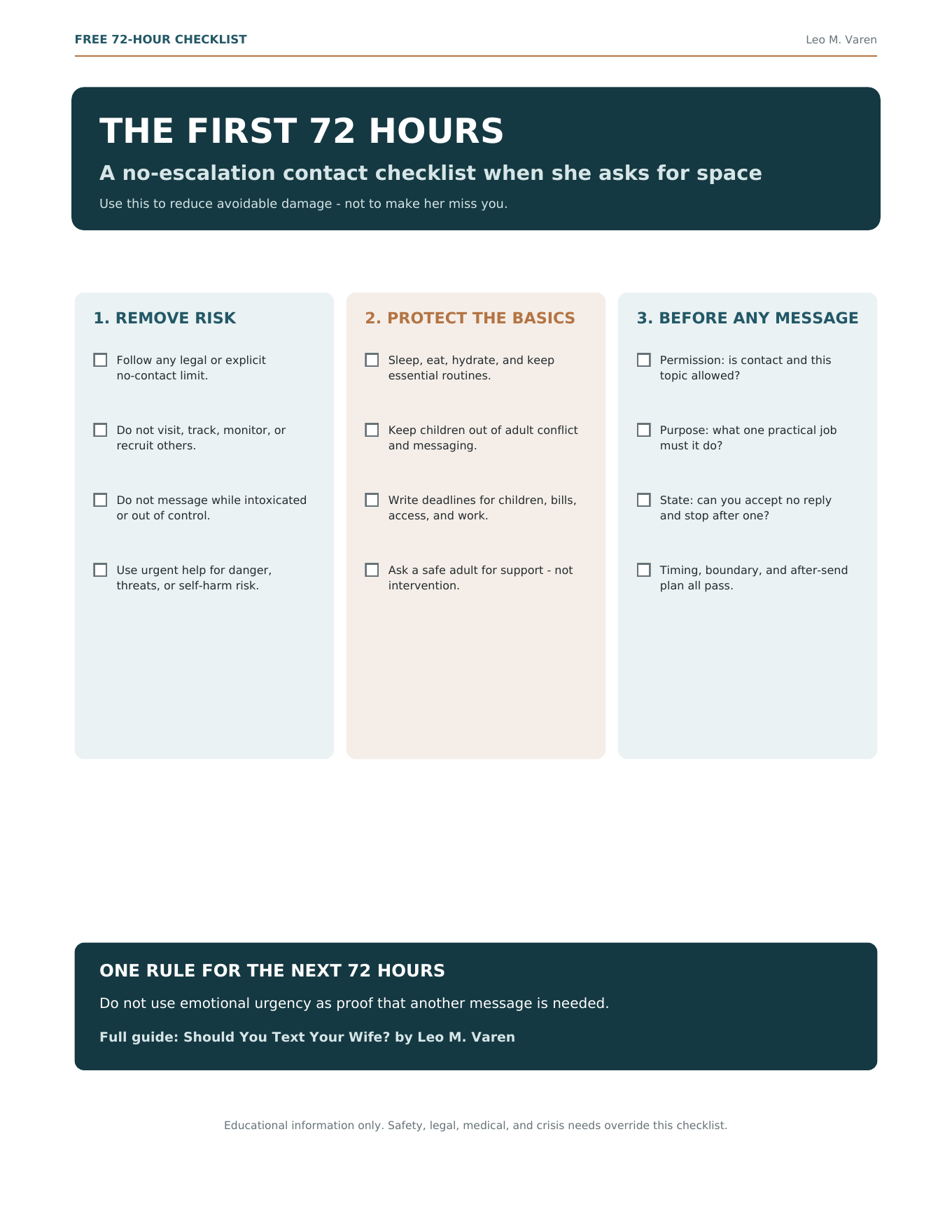
If your wife wants a separation, your first job is not to solve the marriage before bedtime.
Start here:
- clarify what “separation” means in practical terms,
- identify what must change immediately,
- keep children out of the adult conflict,
- separate logistics from relationship conversations,
- do not make major legal or financial commitments you do not understand,
- agree on a practical communication method,
- respect explicit boundaries,
- keep your basic routines functioning,
- set a deliberate time for larger relationship questions when appropriate.
You may still hate the situation.
You may still hope the separation ends.
You may still have no idea what the final outcome will be.
But clear next steps are possible even when the final answer is not.