When your wife asks for space, the phone can suddenly feel like the center of the entire marriage.
You write something.
Delete it.
Rewrite it.
Put the phone down.
Pick it back up five minutes later.
Maybe you are trying to apologize. Maybe you want to explain something. Maybe you just want to know whether she is okay.
And underneath all of it is one question:
Should I text her or leave her alone?
There is no useful answer that starts with a universal number of days.
The better question is:
What job does this message actually need to do?
That question will not remove the uncertainty. But it can help you tell the difference between necessary communication and contact that is mainly trying to make the uncertainty hurt less.
Start with what she actually asked for
Before deciding anything, go back to her actual words.
There is a meaningful difference between:
I need some space.
and:
Please don’t text me right now.
and:
I’ll contact you when I’m ready.
Those are not the same boundary.
If she clearly asked you not to contact her, the default answer is simple:
Do not text her.
Do not look for a technical loophole.
Do not decide that Instagram is different from texting.
Do not send something through a friend.
Do not convince yourself that a “quick check-in” does not count.
If there is a genuine issue involving children, safety, legal obligations, or time-sensitive logistics, necessary communication may still be appropriate.
But feeling anxious about the relationship does not turn emotional contact into necessary contact.
If her request was less specific — for example, “I just need some space” — then there may be more judgment involved.
If you are still working out how to respond to the request itself, begin with what to do first after your wife asks for space.
That is where the rest of this decision process matters.
Ask what the message is supposed to accomplish
Before sending anything, finish this sentence:
The practical purpose of this message is to ________.
Try to answer it without using words such as:
- reassure me
- make her understand
- show her how much I care
- find out where I stand
- get some clarity
Those may be real emotional needs.
But they are not necessarily jobs the message needs to do.
A message has a clearer practical purpose when it needs to handle something like:
- who is picking up the children;
- a schedule change;
- a bill that must be paid today;
- access to the house or car;
- a medical or safety issue;
- a genuinely time-sensitive logistical decision.
Those messages have a job.
They can usually be short.
They do not need to become a hidden relationship conversation.
The contact test: necessary, useful, or soothing?
A useful way to think about a message is to put it into one of three categories.
1. Necessary
Something genuinely has to be handled.
For example:
I can pick up Emma at 4:30 today. Does that work for you?
There is a clear task.
The message does not require an emotional response.
And if she answers only the practical question, that is enough.
2. Potentially useful
The message is not strictly necessary, but there may be a reasonable reason for it.
For example, perhaps she asked for space during an intense conversation and you left without acknowledging what she said.
A brief acknowledgment might sometimes be appropriate:
I heard what you said. I’ll respect the space you’re asking for.
Then stop.
Whether even that message is appropriate depends on the boundary she gave you.
If she explicitly said not to contact her, you do not need to send an acknowledgment just because a generic article says acknowledgments can be helpful.
Her actual request comes first.
3. Mainly soothing
These are the messages that usually feel most urgent.
Are you okay?
Do you still love me?
Can we please talk?
I just want you to know I’m here.
I’ve been thinking about everything.
I promise I can change.
Can you tell me what this means?
There may be nothing cruel or manipulative about wanting to send them.
But ask who the message is mainly trying to soothe.
If the honest answer is me, that matters.
You may be trying to use contact to reduce uncertainty rather than to solve a real communication problem.
A good intention can still create pressure
This is one of the hardest parts.
You may genuinely believe:
I’m not trying to pressure her. I just want her to know how I feel.
Those two things can exist at the same time.
Your intention can be sincere.
The message can still create pressure.
Imagine asking someone for room to think and then receiving:
I know you asked for space, but I just need to say one thing…
Then another message.
Then a clarification.
Then an apology for the clarification.
Each message may look small from the sender’s side.
From the receiving side, it can feel like the request for less contact never really changed anything.
Respecting space is not about pretending you do not care.
It is about accepting that your need to express something does not automatically create an obligation for her to receive it right now.
Do not use practical contact as a doorway into the marriage conversation
This is especially important if you share children, a home, bills, pets, or other responsibilities.
You may genuinely need to communicate.
That does not mean the relationship conversation needs to come along for the ride.
For example:
The dentist moved Noah’s appointment to Thursday at 3:00. I can take him unless you need me to do something different.
That is practical.
This:
The dentist moved Noah’s appointment to Thursday. Also, I’ve been thinking a lot about us and I really feel like if we could just sit down calmly…
is no longer just practical.
If the logistics can stand on their own, let them stand on their own.
Necessary contact works better when it does not carry an emotional invoice attached to it.
Before you send, remove the hidden question
A lot of messages contain a question the sender never actually writes.
For example:
Hope your day went okay.
The hidden question may be:
Will you answer me?
Just wanted you to know I’m thinking of you.
The hidden question may be:
Do you still care?
I’m here if you need anything.
The hidden question may be:
Are you going to come back toward me?
This does not make those sentences inherently bad.
It means you should be honest about what you are asking the message to do.
One useful test is:
If she does not reply at all, will I regret sending this or feel compelled to send another message?
If no reply would immediately trigger another message, the first one may not be as expectation-free as it seems.
If you need to send a practical message, make it easy to answer
Necessary communication should usually be:
- specific;
- brief;
- neutral;
- easy to answer;
- limited to one subject where possible.
Instead of:
We really need to figure out what’s happening with everything because I don’t know what you want me to do about the kids and the house and honestly I feel completely shut out right now.
Try:
I need to confirm tomorrow’s school pickup. I can collect them at 3:30. Let me know if that needs to change.
The second message has a job.
It does not demand emotional processing before she can answer it.
That is especially useful when the relationship itself is already tense.
Do not send a long message because you think this is your only chance
When someone pulls away, there can be a strong fear that silence means losing your opportunity.
So you start writing the definitive message.
Everything you should have said.
Everything you finally understand.
Everything you regret.
Everything you promise to change.
Three screens become seven.
Seven become fifteen.
At some point it starts to feel too important not to send.
But length does not create clarity.
And emotional intensity does not guarantee that someone is in a position to receive what you are saying.
There may eventually be a time for an important conversation.
A request for space is usually not evidence that the right response is to send the longest message of the relationship.
If you need to write it, write it.
You just do not have to send it today.
What if you already sent several messages?
Do not turn that into a new emergency.
A common reaction is:
I already messed this up. I need to send one more message explaining why I sent the others.
That can become an endless loop.
Message.
Correction.
Apology.
Clarification.
Final clarification.
Promise that this is really the last message.
If you have already sent more than you intended, the next useful move may simply be to stop adding to the stack.
You do not always have to repair too much communication with more communication.
We will deal separately with what to do when you have already sent too many messages, because that deserves more than a paragraph here.
What if she texts you first?
Her initiating contact changes the immediate situation, but it does not automatically mean the space is over.
Read what she actually sent.
If she asks:
What time is the school meeting?
answer the school-meeting question.
You do not have to turn a logistical text into:
6:00. Also, does this mean you’re ready to talk about us?
If she initiates a relationship conversation, then you can respond to the conversation she is actually opening.
Do not make every contact carry more meaning than it has.
A message can be a message.
It does not have to be evidence that everything is getting better or worse.
Should you wait for her to text first?
Sometimes yes.
But not because “waiting for her to text first” is a universal relationship technique.
If she clearly said:
I’ll reach out when I’m ready,
then waiting is part of respecting what she asked for.
If she simply said she needs some space and you share practical responsibilities, communication may still happen when something genuinely needs handling.
The exact timing question is more complicated than a simple texting rule.
How long you should give space depends on the situation, whether you live together, whether children are involved, what she actually requested, and whether there is a natural point for a check-in.
That is why How Long Should I Give My Wife Space? is a separate question we will deal with on its own.
Do not turn today’s decision into a thirty-day communication policy.
Decide what this message needs today.
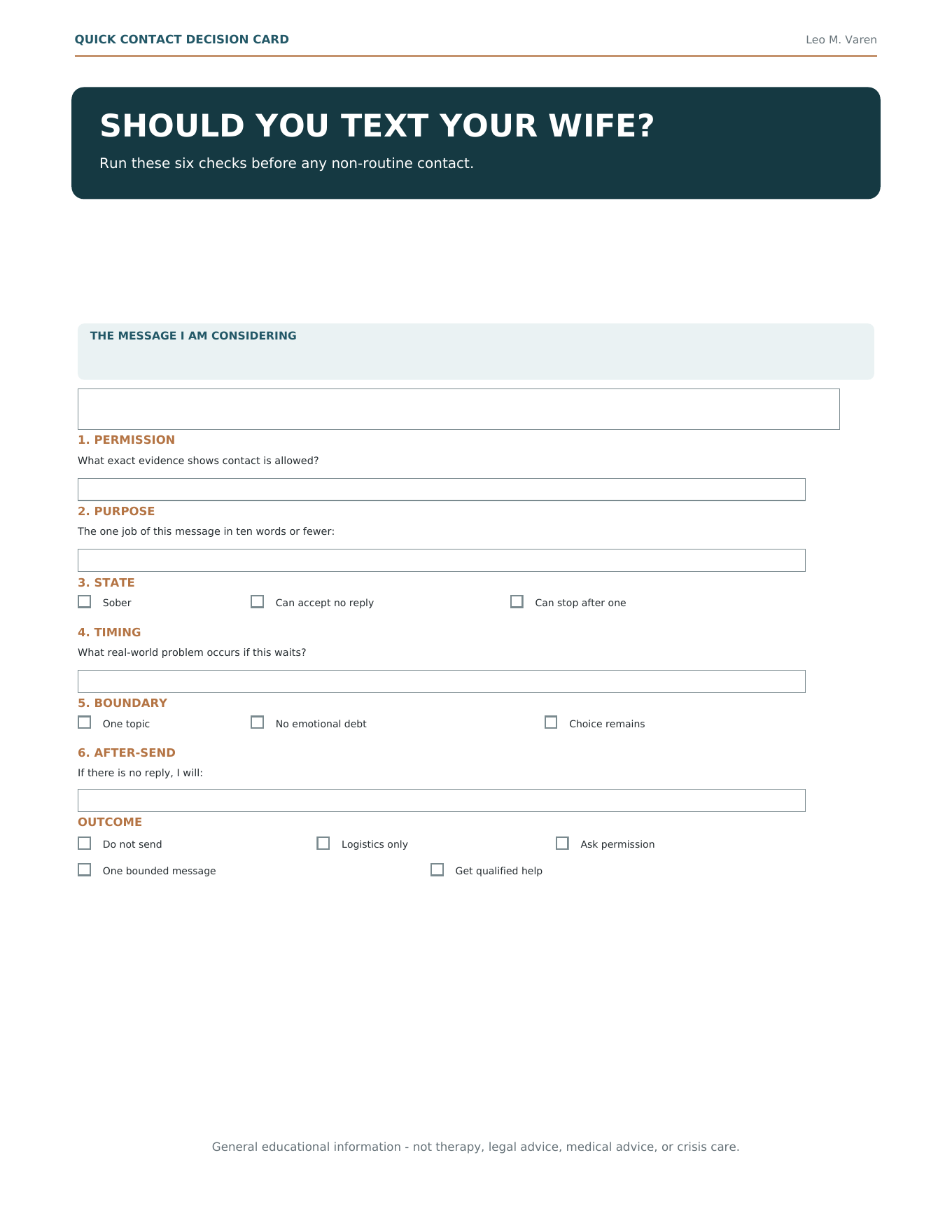
A simple decision process before you press Send
Before sending a non-routine message, ask yourself five questions.
1. Did she clearly ask me not to contact her?
If yes, respect that unless there is a genuine necessary exception.
2. Does this message have a clear practical job?
If you cannot identify one, pause.
3. Does it need to happen today?
Feeling urgent and being urgent are different.
4. Can I send it without reopening the relationship conversation?
If the practical part is buried inside an emotional message, separate them.
5. Can I accept no reply?
If silence would make you immediately send another message, wait before sending the first one.
You are not trying to find the perfect message.
You are trying to avoid sending a message whose real job is to make uncertainty disappear.
No text can reliably do that.
If you are unsure, waiting is also a decision
You do not lose your only chance by waiting an hour.
Or until morning.
You can write the message in Notes.
Walk around the block.
Take a shower.
Go to work.
Sleep.
Read it again when the immediate pressure has dropped.
If the message still has a clear practical purpose later, you can reconsider it.
If its main purpose disappears once you are calmer, that tells you something useful.
Not sending a message is not passive.
Sometimes it is the most deliberate communication decision available.
The rule to remember
When your wife asks for space, do not ask:
What message will make her react the way I want?
Ask:
Does this message have a clear job that genuinely needs doing?
If yes, keep it practical and proportionate.
If no, you probably do not need to send it just because the uncertainty is uncomfortable.
You can care about the marriage without making every feeling into a message.