When your wife asks for space, one of the first things your mind wants is a number.
Three days?
A week?
Two weeks?
Thirty days?
Wait until she texts first?
A number feels useful because uncertainty does not.
If you knew the correct amount of time, you could follow the rule and stop wondering whether you were doing too much or not enough.
The problem is that there is no universal number that works for every marriage.
“Give her space for 30 days” is not a relationship law.
The useful question is not:
How many days should I disappear?
It is:
What did she actually ask for, what still needs to be handled, and what would make a future check-in reasonable rather than pressured?
That gives you a much better way to think about time.
Start with the boundary she actually gave you
“Space” can mean very different things.
Your wife may have said:
I need a couple of days to clear my head.
Or:
I don’t want to talk about the relationship right now.
Or:
Please don’t contact me. I’ll reach out when I’m ready.
Or simply:
I need space.
Those are not interchangeable.
If she gave you a clear timeframe, start there.
If she said:
I need the weekend to myself.
then you do not need to invent a seven-day or thirty-day rule.
Respect the weekend.
If she said:
I’ll contact you when I’m ready.
then repeatedly checking in because an internet rule told you “five days is enough” would ignore the clearer information you already have.
The boundary she actually expressed matters more than a generic countdown.
Do not turn a number into a pressure strategy
The internet is full of rules that sound precise:
Give her 7 days.
Go no contact for 21 days.
Disappear for a month and she’ll start missing you.
The certainty is appealing.
But there is a problem.
A countdown can quietly turn “giving space” into another attempt to control what happens next.
Day 1: She needs space.
Day 4: Has she noticed I am gone?
Day 7: She should be missing me by now.
Day 10: Maybe I should post something so she sees I am doing well.
Day 14: The rule says I can text now.
Now the silence is not really about respecting her request.
It has become a strategy for producing a reaction.
That is not the purpose of space.
You cannot guarantee that a particular number of quiet days will make someone feel closer, safer, clearer, or more interested in reconciliation.
The time is useful if it reduces pressure and gives both of you room to deal with reality.
It is not a timer that makes a marriage reset itself.
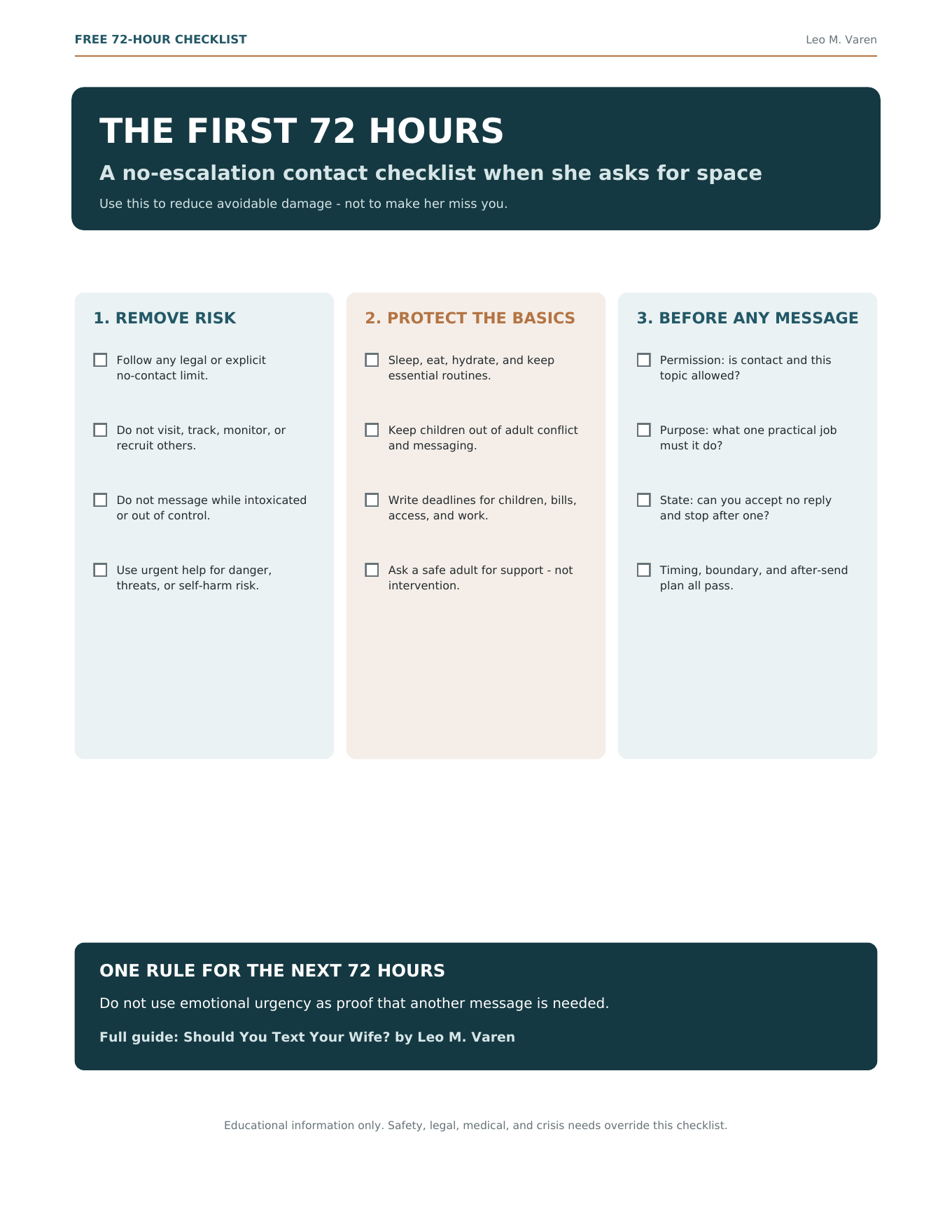
The first 72 hours are different from the next three weeks
It can help to separate the immediate period from the longer question.
The first day or two after a difficult conversation often carries the most emotional urgency.
That is when people are most tempted to:
- send several messages;
- demand clarity;
- make promises;
- ask whether the marriage is over;
- apologize repeatedly;
- make dramatic decisions;
- interpret silence as a final answer.
During that first stretch, the main goal is usually simple:
Do not make the situation harder just because you are scared.
Eat.
Sleep.
Take care of the children.
Go to work.
Handle what genuinely needs handling.
Avoid creating another major relationship conversation simply because you cannot tolerate not knowing what happens next.
That is why we treat The First 72 Hours as its own stage.
For a closer look at the immediate response, begin with what to do first after your wife asks for space.
But after those first days, the question changes.
Now you are not simply trying to avoid reacting.
You are trying to understand what kind of space this actually is.
Ask what “space” looks like in your real life
A request for space when you live in different homes is different from a request for space when you still share a kitchen.
A couple without children may be able to have almost no contact for a period of time.
Parents may still need to talk about:
- school;
- pickups;
- medical appointments;
- activities;
- money for the children;
- schedule changes.
People who share a home may still need to coordinate:
- bills;
- meals;
- sleeping arrangements;
- pets;
- household responsibilities;
- basic use of shared space.
So “giving space” does not always mean literal silence.
Sometimes it means:
reducing unnecessary emotional contact while keeping necessary practical life functioning.
That distinction matters more than whether today is Day 6 or Day 9.
Living together changes what space can realistically mean
If you still live in the same home, disappearing emotionally and physically for an arbitrary period can create its own problems.
You may still pass each other in the kitchen.
You may still need to make dinner for the kids.
You may need to coordinate who uses the car.
Space in that situation may mean:
- not following her from room to room trying to talk;
- not repeatedly asking whether she has made a decision;
- not turning every quiet moment into a relationship discussion;
- giving more physical room where possible;
- keeping practical communication calm and ordinary.
It does not require pretending the other person is invisible.
And it does not mean you need to make the atmosphere hostile in order to prove that you are “giving space.”
We will deal separately with what giving space looks like when you still live together, because that situation deserves its own practical guidance.
Shared children create a different kind of contact
If you have children together, “no contact” may not be realistic even when the marriage is under serious strain.
The useful question becomes:
What communication do the children and practical responsibilities actually require?
You may need to discuss school.
You may need to confirm a pickup.
You may need to coordinate a doctor’s appointment.
That does not necessarily mean it is time to ask:
Have you decided what you want to do about us?
You can communicate about the children without using every practical exchange as an opportunity to check the status of the marriage.
That protects the practical job of the conversation.
It also stops the children from becoming an excuse for unnecessary emotional contact.
We will cover communication about children during space separately rather than trying to solve the entire co-parenting question here.
What if she gave no timeframe at all?
This is the part that creates the most anxiety.
She says:
I need space.
You ask:
How long?
And there is no clear answer.
Maybe she says:
I don’t know.
Now what?
First, do not force someone to give you a timeframe they genuinely do not have.
“I don’t know” can be frustrating.
It is still information.
At the same time, indefinite uncertainty is difficult to live inside forever.
So there is a difference between:
not demanding an answer immediately
and:
agreeing to live without any future point of communication indefinitely.
If she did not give a timeframe, you may eventually need a reasonable point to revisit practical expectations.
But “eventually” does not automatically mean tomorrow morning.
The right moment depends on the context.
Look for a natural check-in point, not a magic day
A check-in works better when there is a reason for it.
For example:
- the weekend she asked for has ended;
- an upcoming family or child-related decision requires coordination;
- you agreed to talk again after a particular event;
- you have been living separately and need to discuss practical next steps;
- enough time has passed that a basic clarification of expectations is reasonable.
That is different from:
It has been seven days because seven days is the rule.
A natural check-in has context.
A countdown only has a number.
If you are considering contact, ask:
Why is this the right time to check in?
Before sending a check-in, use the same practical decision process for whether you should text your wife after she asks for space.
If your only answer is:
Because I cannot stand waiting anymore,
that may be a sign that the timing is being driven by your anxiety rather than by a real change in the situation.
A check-in should not be disguised pressure
Even when a check-in is reasonable, how you do it matters.
A check-in is not:
I gave you the week you asked for, so I need to know whether you’re staying married to me.
That turns space into a debt.
It says:
I complied. Now you owe me clarity.
A more proportionate check-in might be:
I’ve been respecting the space you asked for. I wanted to check whether you’d like more time or whether there’s a point when it would make sense for us to talk.
That does not guarantee a comfortable answer.
It simply asks for clearer expectations without pretending that waiting has purchased a particular outcome.
If she explicitly told you not to contact her until she reaches out, that boundary still matters more than a generic check-in script.
What if she keeps asking for more time?
This can be painful.
You give her a few days.
Then she asks for another week.
Then she says she still does not know.
At some point you may feel:
How long am I supposed to live like this?
That is a fair question.
Respecting someone’s need for space does not mean you have no needs, choices, or boundaries of your own.
You cannot force her to become certain.
But you are allowed to consider what level of uncertainty you can realistically live with.
Eventually the question may shift from:
How long should I give her?
to:
What do I need in order to continue participating in this situation in a healthy and practical way?
That is a different conversation from chasing reassurance.
It may involve living arrangements, finances, parenting, counselling if both people want it, or the first practical steps when your wife wants a separation.
Those larger decisions deserve careful handling.
They should not be forced into the first few days simply because waiting is uncomfortable.
Do not interpret every day of silence
This is difficult because silence leaves room for imagination.
Day 3:
She hasn’t texted. Maybe she is done.
Day 5:
She liked something online. Maybe she is trying to show me something.
Day 8:
She seems calmer. Maybe she misses me.
Day 10:
She still hasn’t brought up the marriage. Maybe I waited too long.
You can build a complete theory out of almost anything.
Try not to.
Silence is not automatically:
- rejection;
- reconciliation;
- punishment;
- proof she misses you;
- proof she does not care.
Sometimes silence simply means there has not been a conversation yet.
Do not make yourself respond to meanings you have invented.
What if she contacts you during the space?
Respond to what she actually opens.
If she asks about the kids, answer about the kids.
If she asks whether you paid the electricity bill, answer that.
If she starts a genuine conversation about the relationship, you can respond to that conversation.
Her texting you does not necessarily mean:
The space is officially over.
And it does not necessarily mean:
This is my chance to say everything.
Do not load one ordinary message with the weight of the entire marriage.
This is another reason a fixed rule such as “never reply during the 30-day no-contact period” often fails real life.
Real relationships have context.
What if you are afraid that giving too much space will make her leave?
This fear makes sense.
You may think:
If I do nothing, she’ll get used to life without me.
So contact starts to feel like keeping the relationship alive.
But repeated contact cannot guarantee closeness either.
If she has asked for less pressure, increasing pressure because you are afraid of losing her may produce exactly the interaction she was asking to step away from.
Giving space does not guarantee reconciliation.
Neither does refusing to give it.
The useful goal is smaller:
Do not make contact decisions solely to control an outcome you cannot control.
You can take your marriage seriously while still respecting another person’s request for room.
So how long should you actually wait?
There is no honest universal answer.
But you can use this sequence.
If she gave a clear timeframe
Respect it.
Do not shorten it just because you feel anxious.
If she said she would contact you
Let her do that unless a genuine practical or safety issue requires contact.
If you share necessary responsibilities
Keep necessary communication practical while reducing unnecessary relationship pressure.
If she gave no timeframe
Give the immediate emotional intensity time to settle before trying to force certainty.
Then look for a natural, proportionate point to clarify expectations rather than choosing an arbitrary countdown.
If the uncertainty continues indefinitely
Remember that you also have the right to think about your own practical and emotional boundaries.
Respecting space does not require permanent limbo.
The rule to remember
Do not ask:
What number of days will make her come back?
Ask:
What does respecting this request look like in our actual situation?
That may mean a quiet weekend.
It may mean practical-only communication for a while.
It may mean waiting for her to initiate contact.
It may eventually mean a calm check-in about what happens next.
The right amount of space is not the number that produces the reaction you want.
It is the amount of room that respects what was actually asked for while still allowing necessary life and, eventually, reasonable clarity.