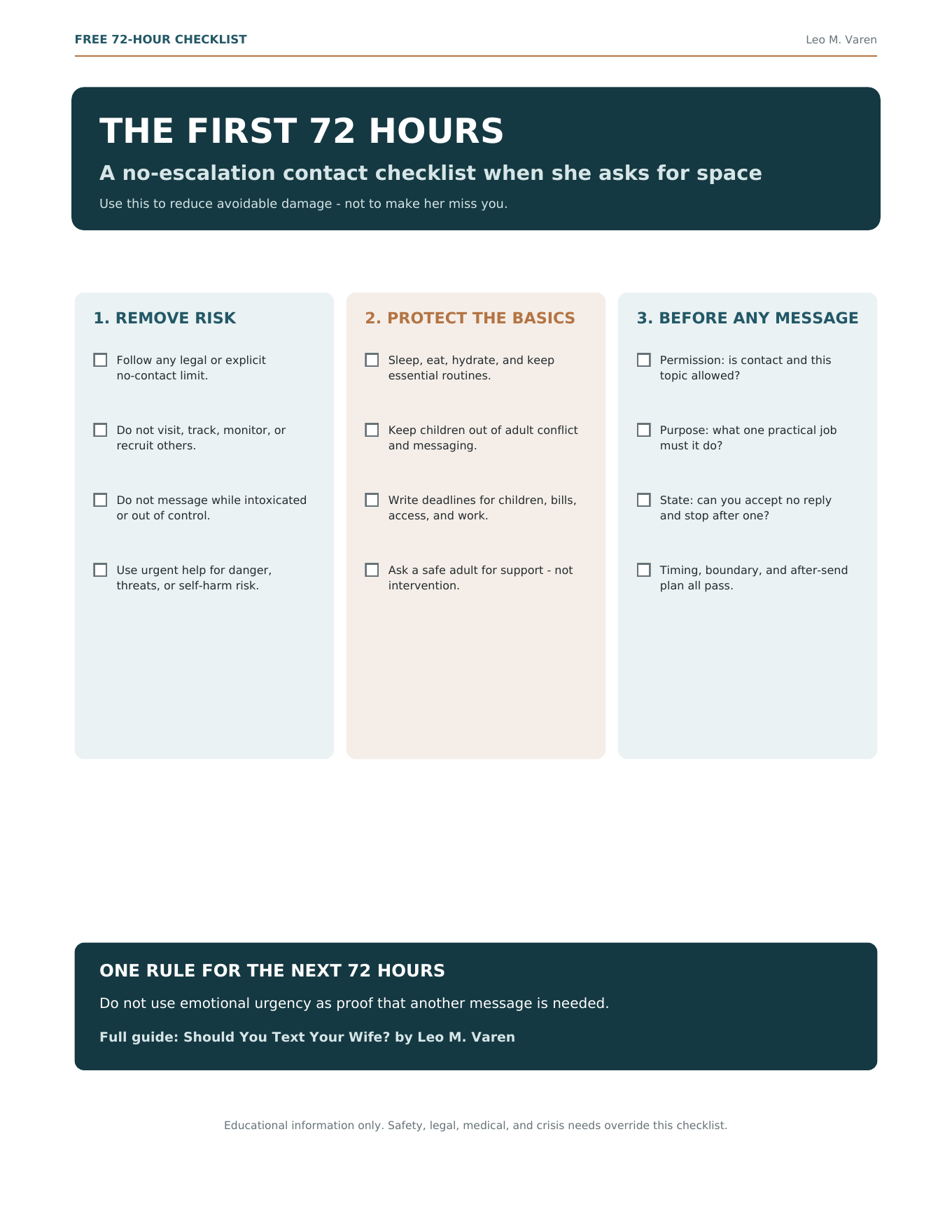
You may already know you should probably stop texting.
That does not mean the urge disappears.
You put the phone down.
Ten minutes later you pick it up again.
You reread the last conversation.
You notice she has not replied.
You think of one more thing you should explain.
Then another.
You tell yourself:
This one is different.
This one is clearer.
This one will finally explain what I mean.
I just need to send this and then I’ll stop.
That last sentence is often the trap.
Because the problem may no longer be the content of the message.
The problem may be that sending something has become the quickest way to reduce the discomfort you are feeling right now.
And when contact becomes a way to regulate anxiety, one message rarely feels like enough for very long.
The urge is real even when the message is unnecessary
This matters.
You do not have to pretend the impulse is irrational or fake.
It may feel physical.
Restlessness.
Tightness in your chest.
A need to do something.
You may feel that if you do not send the message, something important will be lost.
Maybe she will think you do not care.
Maybe she will misunderstand you.
Maybe she will make a decision without hearing your side.
Maybe silence will become permanent.
Those fears can make a message feel urgent even when nothing practical needs to happen.
So start by separating two things:
The urge to send is real.
That does not mean the message is necessary.
Both can be true at the same time.
If the request for space has just happened, begin with what to do first after your wife asks for space.
Do not make yourself decide forever
When you are fighting the urge to text, “I can never message her again” feels enormous.
So do not make that decision.
You usually only need to decide:
Am I sending this message right now?
Not tonight forever.
Not for the next month.
Not for the rest of the marriage.
Just now.
That makes the problem smaller.
You are not trying to become perfectly calm.
You are trying to create enough distance between the urge and the action that you can choose instead of react.
Move the message somewhere else
If the words are pushing around in your head, write them.
Just do not put them in the message box.
Use Notes.
A document.
A piece of paper.
An email draft addressed to yourself.
Write everything you want to say.
Do not edit it for effect.
Do not make it persuasive.
Do not imagine how she will respond.
Just get it out of your head.
This can help because your brain no longer has to keep repeating:
Do not forget to tell her this.
You have not lost the thought.
You have simply separated writing from sending.
Those are two different actions.
Use a waiting window
When the urge is strong, make a temporary rule.
For example:
I will not send any non-practical message for the next 60 minutes.
Or:
I will reread this tomorrow morning before deciding.
The exact waiting period is less important than the interruption.
The goal is not to use a magical number.
The goal is to stop the impulse from moving directly into action.
A message that still has a clear practical purpose after sleep is different from one that only felt essential at 11:47 p.m.
Time does not solve every decision.
But it often reveals which messages were being powered mostly by the emotional moment.
For the wider timing question, read how long to give your wife space.
Get away from the screen
This sounds obvious because it is.
And that is why it works better than complicated relationship analysis in the middle of an urge.
Stand up.
Leave the room.
Take a shower.
Walk outside.
Do the dishes.
Go to the gym.
Drive somewhere only if you are calm enough to drive safely.
Take the dog out.
Fold laundry.
Make food.
Do anything ordinary that moves you into a different physical environment.
The phone makes the next message feel one thumb movement away.
Changing your environment adds friction.
Friction is useful when you are trying not to act automatically.
Stop rereading the conversation for new meaning
Rereading can feel productive.
Usually you are searching.
For a clue.
A warmer word.
A colder word.
A punctuation mark.
A sentence that proves she still cares.
A sentence that proves she is done.
The same conversation starts producing a different theory every twenty minutes.
At some point, you are no longer reading what she wrote.
You are using the conversation as material for anxiety.
If you have already read it several times, another reading is unlikely to produce the certainty you are looking for.
Put the thread away.
You do not need to keep reopening the wound to make sure it is still there.
Be careful with “one last message”
“One last message” is rarely dangerous because of the number one.
It is dangerous because of the pattern behind it.
The sequence often looks like this:
I just need to explain.
Then:
I need to clarify the explanation.
Then:
I think the clarification sounded wrong.
Then:
I should apologize for how that sounded.
Then:
I need to tell her I won’t send anything else.
The final message creates a reason for another final message.
If you have said something important already, ask:
What information is genuinely missing?
Not:
What feeling has not been expressed perfectly yet?
Relationships do not become clear because every sentence has been optimized.
Sometimes the next useful communication is no communication.
Do not use apology as a reason to keep contact going
Apologies can matter.
But they can also become another loop.
You send:
I’m sorry for pushing.
Then ten minutes later:
I also want to apologize for how I said that.
Then:
I don’t want you to feel like I’m trying to manipulate you.
Then:
Sorry, I know I’m messaging again after saying I wouldn’t.
Now the apology itself is creating the behavior you are apologizing for.
If you have already acknowledged that you were pushing, another apology may not improve the situation.
Sometimes the most credible apology is behavioral:
stop repeating the thing you said you were sorry for.
Ask what you want the reply to give you
Before sending, imagine she replies.
What answer are you hoping for?
I still love you.
I’m not leaving.
I miss you.
I’m ready to talk.
Everything is going to be okay.
Now imagine she does not send that answer.
Would you want to send another message?
If yes, the message may be less about communication and more about trying to obtain emotional certainty.
That does not make you weak.
It tells you where the pressure is coming from.
The need may be real.
But your wife may not be the right person to regulate that need in the exact moment she has asked for space.
Put the reassurance somewhere else
You still need somewhere for the emotion to go.
So use a safer outlet.
Call one sensible friend.
Write in a journal.
Talk to a therapist or counsellor if you already have one or want professional support.
Go somewhere public and quiet.
Exercise.
Work.
Pray, meditate, or sit quietly if that is part of your life.
Do something that reminds you your entire nervous system is not contained inside one text thread.
The goal is not to suppress everything.
It is to stop making your wife the only place where your uncertainty can go.
Avoid asking six people what the message means
Support can help.
Too many opinions often make things worse.
One friend says:
Fight for her.
Another says:
Go completely silent.
Another says:
Send flowers.
Another says:
She’s testing you.
Another says:
It’s definitely over.
Now you have six theories and more anxiety than before.
Choose one or two grounded people who will not turn your marriage into entertainment.
Ask for help with your behavior, not predictions about her mind.
Better question:
I keep wanting to send another message. Can you help me not do that tonight?
Less useful:
What do you think she really means?
The first question gives someone a practical job.
The second creates more speculation.
Create one simple rule for tonight
When your head is overloaded, complicated plans fail.
Use one rule.
For example:
No relationship messages tonight. Practical issues only.
Or:
Nothing gets sent until I sleep and reread it tomorrow.
Or:
If I want to send something, it goes into Notes first.
One rule is easier to follow than twenty pieces of advice.
You can make a different decision tomorrow if circumstances change.
Tonight, you only need something clear enough to keep panic from driving.
If you keep checking whether she is online
This is the digital version of sending another message.
You may not be contacting her.
But you are still monitoring.
Last seen.
Online status.
Instagram activity.
Stories.
Likes.
Whether she viewed something.
Whether she changed a profile photo.
Whether she followed someone.
Each check promises information.
Usually it gives you another reason to check.
If this is happening, add friction.
Mute notifications.
Move the app off your home screen.
Log out for the evening.
Turn off activity indicators where appropriate.
Put your phone in another room.
You are not trying to punish her or play a game.
You are reducing access to a behavior that is keeping you activated.
Do not post something for her to see
This is another form of indirect contact.
You think:
I won’t text her. I’ll just post something positive.
Maybe a gym photo.
A quote.
A night out.
Something about growth.
Something about loyalty.
Something that only one person is really meant to notice.
If the post has a hidden audience of one, it may still be part of the same pursuit.
Ask:
Would I post this if I knew she could not see it?
If the answer is no, wait.
Social media does not become healthy distance just because the message is public instead of private.
If you already sent too much, stop repairing it
Maybe you are reading this after sending five messages.
Or ten.
Maybe she has not replied.
Maybe you feel embarrassed.
The temptation now is:
I need to explain that I know I sent too much.
You probably do not need a live commentary on the mistake.
If the messages are already there, they are already there.
You cannot unsend the emotional effect by adding more words.
Unless there is something genuinely necessary or safety-related, the next useful move may simply be to stop.
Not forever.
Just stop adding to the pile.
We can deal separately with what to do after you have already sent too many messages, because that situation deserves its own article.
What if the message actually is practical?
Then practical contact may still be appropriate.
Children.
Scheduling.
Bills.
Medication.
Travel.
A property issue.
Something genuinely time-sensitive.
The question is not whether you are “allowed” to communicate.
It is whether the message has a real job.
For the full contact test, use whether you should text your wife after she asks for space.
If it does, keep the job visible.
For example:
I need to confirm whether I’m picking up the kids at 4:00. Please let me know by 2:00 if that has changed.
That is different from:
I need to know about pickup. Also, I hate how distant we’ve become and I don’t understand why you won’t talk to me.
If the practical part can exist alone, let it exist alone.
Use the 20-minute test
If you are unsure whether the urge is emotional or practical, try this.
Do nothing for 20 minutes.
No rereading.
No drafting.
No checking online status.
No asking a friend what it means.
Do something physical or ordinary.
Then ask:
Does the same practical need still exist?
If yes, you can evaluate the message again.
If no, what felt urgent may have been the emotional wave.
Twenty minutes is not magic.
It is just long enough to create some space between feeling and action.
Watch the time of day
Late-night messages deserve extra suspicion.
Not because nothing important happens at night.
But because tired, lonely, activated brains tend to create urgency.
Everything feels final at 1:15 a.m.
A short silence feels enormous.
A draft becomes a speech.
A fear becomes a conclusion.
If there is no genuine emergency, morning is often a better decision-maker than midnight.
Sleep before sending the message that feels like it will determine the future of your marriage.
Do not confuse restraint with passivity
Not sending is still doing something.
You are choosing:
- not to add pressure;
- not to ask for another reassurance cycle;
- not to escalate uncertainty;
- not to make your fear someone else’s immediate responsibility.
That takes more control than firing off another paragraph.
Restraint is not a trick to get a reaction.
It is not “high-value silence.”
It is simply the decision not to make the situation harder because you are uncomfortable.
The urge will come back
You may handle one wave well.
Then two hours later it comes back.
That does not mean your strategy failed.
Urges rise and fall.
You do not need to eliminate the feeling completely.
You need to get through the peak without automatically acting on it.
Every time you do that, you make the next decision a little less reactive.
Not because you are training yourself to be cold.
Because you are learning that discomfort can exist without immediately becoming contact.
A simple emergency plan for the next message urge
If you feel like you are about to send something you will regret, use this sequence:
1. Put the phone down.
Physically.
2. Write the message somewhere else.
Notes, paper, document.
3. Wait 20 minutes.
No checking her status.
4. Move your body.
Walk, shower, clean, exercise.
5. Ask what job the message has.
Practical or emotional?
6. Ask whether it must happen today.
If not, wait.
7. If you are still unsure, do not send yet.
Uncertainty does not require immediate action.
This is not a perfect system.
It is simply a way to interrupt the automatic sequence:
feel → type → send → regret → send again.
The rule to remember
When you feel the urge to send another message, do not ask:
How do I make this urge disappear?
Ask:
What can I do for the next 20 minutes without making contact?
That is usually a much easier problem to solve.
You do not need to solve the marriage tonight.
You do not even need to solve the whole day.
Sometimes the next useful step is simply getting through the next twenty minutes without turning anxiety into another message.