When your wife says:
“I need space.”
your mind may immediately try to translate it.
She’s leaving.
She doesn’t love me anymore.
There must be someone else.
She wants me to chase her.
She’s testing whether I care.
She just needs a few days and everything will be fine.
The problem is that one sentence cannot reliably tell you any of those things.
“I need space” is important information.
But it is not a complete diagnosis of the marriage.
The most useful way to understand it is to separate:
what the phrase actually tells you
from:
what fear, hope, or internet advice may be adding to it.
What “I need space” does tell you
At minimum, it tells you that the current level or kind of interaction feels like too much for her right now.
That may involve:
- conflict;
- emotional intensity;
- repeated conversations about the relationship;
- feeling watched or questioned;
- needing time to think;
- needing physical distance;
- uncertainty about what she wants;
- general overwhelm that is not entirely about the marriage.
You may not know which one is true.
But you do know something important:
more of the same interaction is probably not what she is asking for in that moment.
If the last several days have involved long conversations, arguments, repeated texting, promises, questions, apologies, or attempts to get clarity, “I need space” may simply mean:
I cannot keep doing this conversation right now.
That deserves to be taken seriously even before you fully understand everything behind it.
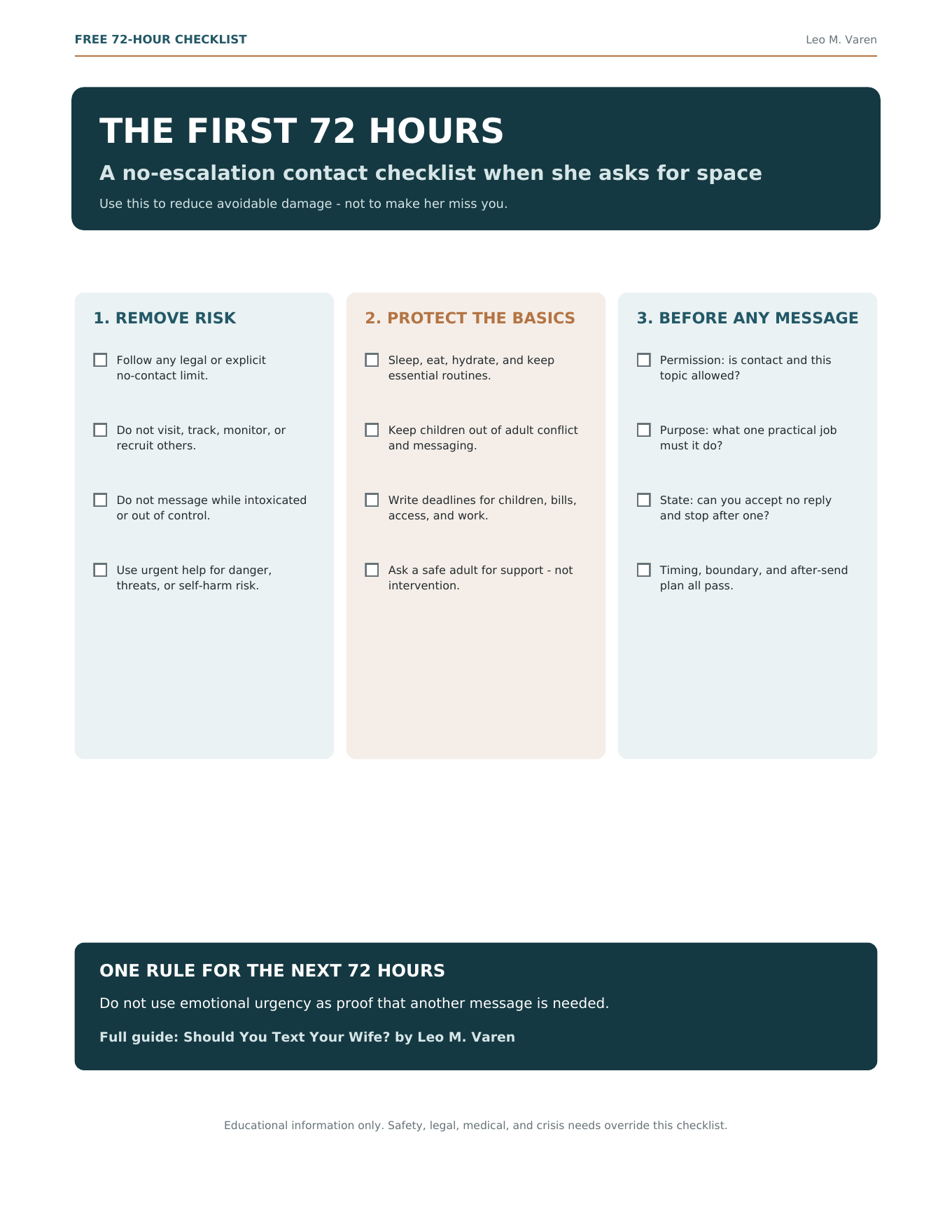
If the request has just happened, begin with what to do first after your wife asks for space.
It does not automatically mean the marriage is over
This is often the first fear.
Your wife asks for space.
Your mind hears:
She has already decided to leave.
Sometimes a request for space does happen during a marriage that is moving toward separation.
But the phrase itself does not prove that.
A person can need distance while still being uncertain.
She can care about the marriage and still feel overwhelmed by the way you are currently interacting.
She can be angry and still not know what she wants long term.
She can need quiet without having made a final decision.
Do not force the phrase to answer a question it did not answer.
If she says:
I want a divorce.
that is different information.
If she says:
I don’t know what I want. I need some space.
then uncertainty is part of the information.
Treat the words she actually used as more reliable than the conclusion your fear immediately created.
It does not automatically mean she still wants the marriage either
The opposite mistake is just as easy.
You may think:
If she only wanted space, that means she hasn’t given up.
Maybe.
Maybe not.
“I need space” should not be turned into reassurance simply because the alternative feels frightening.
Sometimes people ask for distance because they genuinely do not know what they want.
Sometimes because they are exhausted.
Sometimes because they are thinking seriously about separation.
Sometimes because they do not want to continue the conversation in its current form.
The phrase may leave the future open.
But open is not the same thing as positive.
You do not need to turn uncertainty into either catastrophe or hope.
You can let it remain uncertain for now.
The words around “I need space” matter
The sentence rarely appears in isolation.
Compare:
I love you, but I’m overwhelmed and need the weekend to myself.
with:
I can’t keep doing this. Please don’t contact me. I need space.
and:
I don’t know what I want anymore. I think we need some time apart.
All three include the idea of space.
But the surrounding information is different.
Look at:
- whether she named a timeframe;
- whether she asked for no contact;
- whether she mentioned separation;
- whether she described a specific problem;
- whether you still live together;
- whether she asked for physical distance;
- whether she wants relationship conversations to stop temporarily;
- whether she said she would contact you.
Do not strip out the two words “need space” and ignore everything else she said.
The surrounding sentence may tell you much more than the phrase itself.
When timing becomes the question, use the fuller framework for how long to give your wife space.
The context before she said it matters too
Ask what was happening immediately before the request.
Was there one major argument?
Have you been having the same relationship conversation every night?
Have you been asking repeatedly whether she still loves you?
Has she been saying for weeks that she feels overwhelmed?
Did she ask for space after you sent several long messages?
Has she recently talked about separation?
Are there pressures outside the marriage — work, family, health, grief, exhaustion — that may also be affecting her?
Context does not let you read her mind.
But it helps you avoid treating every request for space as identical.
A request after one explosive argument may be different from a request after six months of repeated conflict.
The words matter.
The pattern matters too.
Sometimes “space” means less relationship talk, not zero practical contact
This is especially important if you share children, a home, money, pets, or schedules.
Your wife may not want to talk about:
“Where is this marriage going?”
while still needing to discuss:
“Who is taking the kids to school?”
Those are different kinds of communication.
Space can mean reducing emotional pressure without stopping necessary practical life.
That does not give you permission to hide relationship questions inside logistical messages.
If the message is about school pickup, let it be about school pickup.
If she asked you not to contact her at all, that boundary needs to be treated more carefully.
But do not assume that “space” always means pretending the other person does not exist.
For a specific message, use the practical test for whether you should text your wife after she asks for space.
Sometimes it means “I do not know what I feel yet”
Uncertainty is uncomfortable.
Especially when the uncertain person is your wife.
You may want her to decide.
Stay or leave.
Try or stop trying.
Talk or do not talk.
But sometimes a person genuinely does not know.
That answer can be deeply frustrating because there is nothing concrete to react to.
You cannot solve:
“I don’t know”
by asking the same question in ten different ways.
You may eventually need clearer expectations.
But pushing someone to become certain before they are certain usually does not produce genuine clarity.
It often produces an answer designed to end the pressure.
Sometimes the uncomfortable truth is simply:
she does not know yet.
Sometimes it means “I know what I don’t want right now”
A person may not know what they want long term while being very clear about what they do not want today.
For example:
I don’t want another argument tonight.
I don’t want to keep explaining myself.
I don’t want more messages.
I don’t want to talk about reconciliation right now.
That distinction matters.
You do not need to know the final destination of the marriage to respect a clear short-term boundary.
If the only clear information you have is:
less pressure right now
then that is still enough information to change how you behave today.
Do not assume “space” is a test
A lot of relationship advice encourages this idea.
She wants to see whether you’ll fight for her.
She wants you to chase.
She says space, but secretly she wants reassurance.
That is dangerous territory.
You cannot safely build your behavior around an imagined hidden instruction that contradicts the words she actually used.
If someone says they need less contact, the responsible default is not:
She probably means more contact, but in the right way.
Treating boundaries as secret tests turns communication into mind-reading.
That is exactly what we are trying to avoid.
If she later tells you something different, you can respond to the new information.
Until then, use the information you actually have.
Do not assume “space” means she wants you to disappear to make her miss you
The other popular interpretation is:
Great. This is where I go silent until she misses me.
That turns space into a tactic.
Now you are not respecting a request.
You are running an experiment on her reaction.
You start watching:
- whether she checks your social media;
- whether she texts first;
- whether she sounds warmer;
- whether she seems jealous;
- whether she asks what you are doing.
That keeps you psychologically attached to every signal.
And it can turn quiet into another form of pursuit.
Space is healthier when you stop treating it as a lever.
You do not need to manufacture absence.
You need to stop adding unnecessary pressure.
Her behavior during space may not tell you what you think it tells you
She may appear calm.
That does not automatically mean she is happier without you.
She may appear upset.
That does not automatically mean she wants you back.
She may text about something practical.
That does not automatically mean she is ready to talk about the marriage.
She may not text at all.
That does not automatically tell you the final outcome.
When you are scared, almost every behavior can start looking like evidence.
Try not to build conclusions from individual signals.
Wait for clearer communication.
A normal text is not necessarily a reconciliation signal.
A quiet day is not necessarily a separation announcement.
What if she says she needs space but still acts normal sometimes?
This can be confusing.
Maybe she jokes with you.
Maybe she asks whether you want coffee.
Maybe you have one calm evening.
Then the next day she seems distant again.
You may immediately think:
So the space is over.
Not necessarily.
People are not emotionally consistent machines.
Someone can need distance from relationship pressure and still enjoy a normal conversation.
She can feel warmth toward you and still be uncertain.
She can laugh with you and still need time.
Do not force every ordinary moment to answer the larger marriage question.
Let a good moment be a good moment.
You do not need to convert it into:
“Does this mean we’re okay now?”
What if she says “I need space” after every difficult conversation?
That is a different pattern.
One request for space may be a healthy pause.
Repeated requests for distance every time an important issue appears may eventually raise a broader question about how the relationship handles conflict.
But that is not something to diagnose from one article.
You may eventually need to ask whether the two of you can have difficult conversations in a way that both people can tolerate.
That is different from deciding that every pause is wrong.
Space can be useful.
Avoidance can also become a pattern.
The difference usually becomes clearer over time, not in the first hour after someone asks for distance.
Should you ask what she means by “space”?
Sometimes a short clarification is reasonable.
Especially if practical life makes the request ambiguous.
For example:
When you say you need space, do you mean you’d rather not talk about the relationship for now, or would you prefer no contact unless something practical comes up?
That is different from interrogating her:
How long?
What exactly are you thinking?
Are you leaving?
Do you still love me?
Is there someone else?
When will you know?
A clarification question should clarify the boundary.
It should not force her to explain the entire future of the marriage on demand.
And if she already gave you a clear boundary, you do not need to keep asking for a better answer.
What “I need space” does not tell you
The phrase alone does not prove:
- she wants a divorce;
- she does not love you;
- she is having an affair;
- she wants you to chase her;
- she wants you to disappear;
- she is testing you;
- reconciliation is likely;
- reconciliation is impossible;
- there is a specific number of days you should wait.
Those conclusions require information you do not yet have.
What you do have is simpler:
she is asking for some form of reduced pressure, distance, or room to think.
Start there.
So what should you do with the phrase?
Take it seriously.
Do not dramatize it into a final verdict.
Do not minimize it into something she will “get over.”
Do not decode it as a secret strategy.
Do not immediately demand a full explanation.
Listen to the specific boundary.
Look at the context.
Handle necessary practical responsibilities.
Then give the situation enough room for clearer information to emerge.
The goal is not to become passive.
The goal is to stop reacting to meanings that have not actually been communicated.
The rule to remember
When your wife says:
“I need space,”
do not ask:
What does she secretly mean?
Ask:
What has she actually told me, and what does respecting that look like today?
You may learn more later.
You probably will.
But you do not need to invent the missing information tonight.